
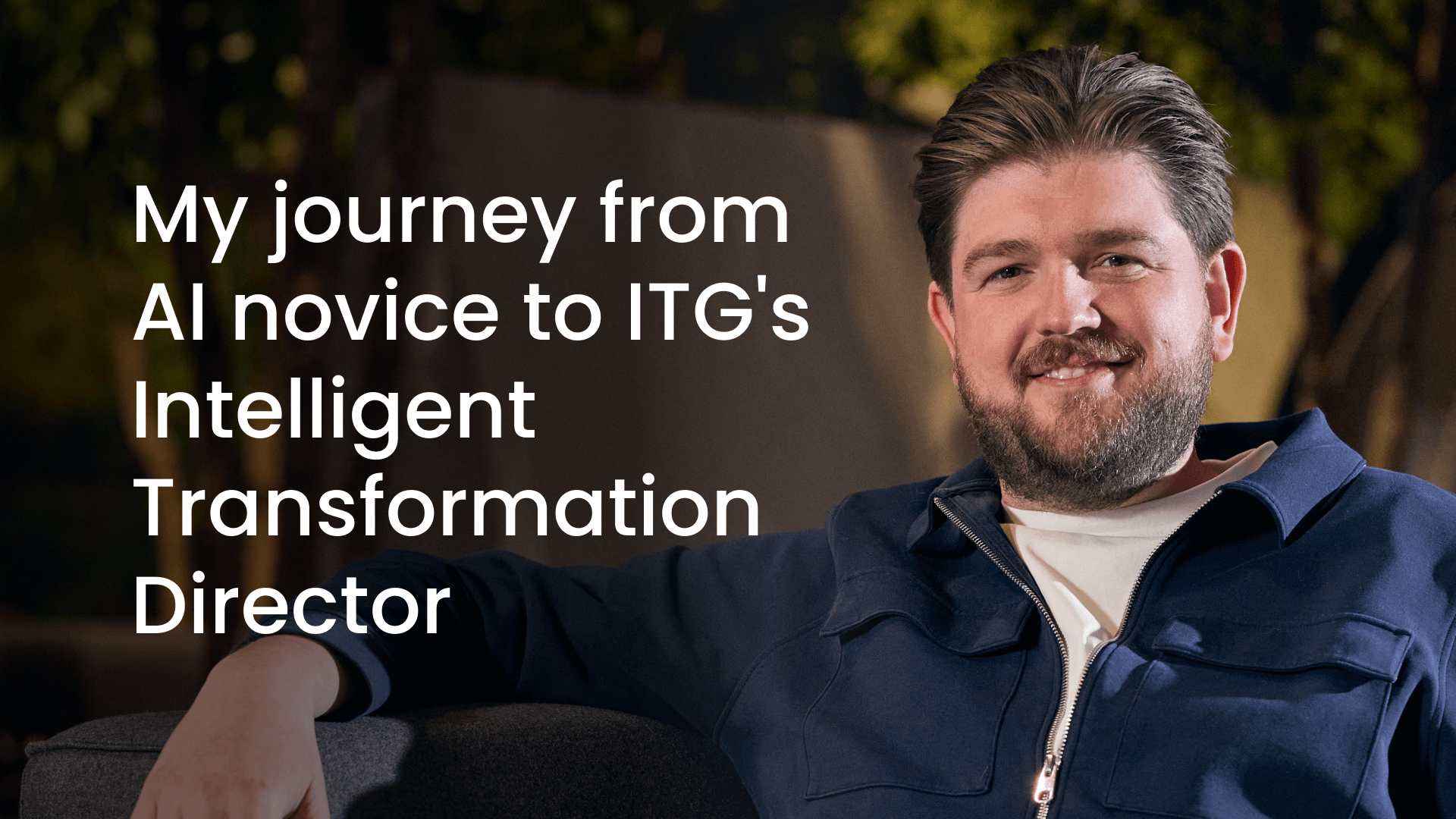
Ben Gallagher reflects on a remarkable 18-month journey from using AI to solve challenges within his role to helping lead ITG’s AI roadmap as Intelligent Transformation Director.
If you’d told me a few years ago that I’d be leading AI‑enabled transformation across a 2,100‑person organisation, I probably would’ve laughed. I didn’t come from engineering. I didn’t study computer science. In fact, the closest I got to “coding” during my 15+ years in Client Services was a complicated Excel formula.
Eighteen months ago, I made a small change that didn’t feel transformational at the time — I configured an API call to automatically correct brand names on around 100 shelf talkers. It was a narrow problem, but an annoyingly persistent one.
To do it, I had to write a business case. And I remember realising I wasn’t really writing it for the business — I was writing it to convince myself that this was something I could actually do. At that point, my world was still relationships, delivery, and making sure things happened when they needed to happen.
But that small experiment changed how I thought about my role — and what was possible. And that’s exactly why this shift happened — and why I believe roles like mine will become increasingly common.
My journey into AI didn’t begin with a course or a mandate. It started because I could see problems everywhere — workflows held together with human judgement, admin loops that teams had stopped noticing, and processes that had quietly become painful over time.
And suddenly, thanks to the tools emerging in 2024 and 2025, I could do something about it. Low‑code and no‑code AI meant I no longer had to be an engineer to build prototypes that actually worked. So I paid for my own licences, carved out time, and built things that solved real problems in the business.
Those early wins — small automations that removed hours of repetitive work — changed everything. What started with merging spreadsheets or rebuilding dull, manual steps turned into a new way of looking at operational problems. I realised that domain knowledge wasn’t just useful; it was now a building material. The people who understand the work most deeply are often the best positioned to rethink it. That realisation became the foundation of what we now call Operational AI at ITG.
By 2025, improving how we get work done had stopped being a side mission and become my primary focus. I moved away from day‑to‑day client management and into Intelligent Transformation — taking everything I had learned from real accounts, real problems, and real teams, and applying it at scale.
The goal was simple: clearer inputs, cleaner handovers, less re‑keying, and fewer late checks. Then, and only then, use automation and AI where they genuinely help.
In early 2026, that shift became official when I stepped into the role of Intelligent Transformation Director. And the most surprising part? The work isn’t really “AI work.” At its core, it’s decision design. Every automation is a decision in disguise — what the inputs need to be, what rules apply, what counts as an exception, and when humans step back in. If you don’t understand how work actually moves through a system, AI will only make the chaos happen faster.
The role has also changed what leadership means for me. Early on, everything ran through me — every idea, every proof of concept, every choice about what to automate next. It wasn’t sustainable. The real breakthrough happened when the work shifted from “building things myself” to enabling others to build for themselves.
When a colleague who’d never touched automation tools solved an operational challenge in days, it confirmed what I’d suspected all along: transformation isn’t something you deliver to people. It’s something you unlock within them.
Today, I oversee a portfolio of more than 100 AI and automation initiatives. And the hardest part isn’t building any of them — it’s deciding what not to build. Prioritisation becomes the discipline that keeps a transformation programme honest.
Looking back, the gap between where I started and where I am now feels far smaller than it once did. The tools are ready. The problems are visible. What most people need isn’t permission — it’s someone to show them that the barrier between “people who build things” and “people who use things” is disappearing faster than anyone realises.
Want to know more about how we’re supporting our clients to unlock AI’s full potential in their operations? Fill in the form below.